
JUNO - Explorer of a Planet on Steroids
For nearly ten years now, the spacecraft Juno has been orbiting Jupiter, the largest planet in our solar system. The results have been astonishing. “I’ve never been involved in a space mission where so many of our assumptions turned out to be wrong.”
The first star you think you see tonight is actually a planet: during these winter months, Jupiter is the brightest object in the night sky. The name is well chosen: the Roman king of the gods was dominant, capricious and omnipresent. No planet in the solar system is larger or more massive than this gas giant.
Viewed through binoculars or a small telescope, Jupiter becomes more than a point of light. Four small dots shift around it night after night. It was those moons – Io, Europa, Ganymede and Callisto – that led Galileo Galilei in 1610 to realize that not everything in the universe revolves around Earth. Since then, we have learned a great deal about Jupiter. It contains more than twice as much mass as all the other planets combined; it forms the gravitational center of an extensive system of nearly one hundred moons; its gravity shaped the architecture of the young solar system and likely shielded Earth from part of the cosmic debris that circulated in those early days. We know how its cloud bands rage, how its magnetic field dominates everything around it, and how extreme its auroras are.
Yet almost all that knowledge came from the outside: from telescopes, flyby missions and measurements of its cloud tops. Only once – with the Galileo probe in the late 1990s – was Jupiter’s atmosphere actually entered. That provided a snapshot at a single location, not a full scan. One question therefore remained unanswered for all that time: what happens beneath those turbulent clouds?
That question formed the core of the spacecraft Juno, appropriately named after Jupiter’s wife: the Roman goddess who, according to myth, was the only one able to see through her adulterous husband’s cloud veil. Juno was launched in 2011, reached Jupiter four years later, and has been orbiting the planet ever since. “One of Juno’s primary objectives is to look inside Jupiter in every way we know how,” says Scott Bolton, principal investigator of the mission. “And I’ve never been involved in a mission where so many of our assumptions were proven wrong.”
Bolton has been fascinated by Jupiter for decades. The planet likely formed early, shortly after the birth of the Sun, and therefore played a decisive role in the further evolution of the planetary system. Jupiter grabbed most of the leftover material: the remnants from which the other planets also formed. “If we want to understand how planets were made, where the material that made us came from, we need to understand Jupiter,” he says.
Jupiter is not just a “bite of Sun.” Although it consists largely of hydrogen and helium, like the Sun, the Galileo mission showed that its atmosphere is enriched in heavier elements – an indication that more is going on than primordial material alone. That combination – familiar yet inscrutable – made Jupiter irresistible to Bolton. Shortly after completing his PhD in the early 1990s, he began thinking about a mission that would finally inspect the interior of this planet.
That idea eventually became Juno, a mission with which Bolton has been involved from the very beginning. The spacecraft moves in an extreme orbit, perpendicular over Jupiter’s poles. Each orbit lasts a little over fifty days, carrying Juno far away from the planet before bringing it back in a close pass only a few thousand kilometers above the cloud tops. That is dangerously close: Jupiter’s radiation belts are among the most intense in the solar system. “Each new orbit takes us into a more hazardous radiation region,” says Bolton. The most important electronics are therefore housed in a titanium “radiation vault” to slow down the degradation as much as possible.
But even that is not the greatest obstacle; Jupiter is a planet you simply cannot descend into. The atmosphere becomes denser extremely rapidly, and the pressure rises so high that any probe descending deeper would inevitably be crushed and absorbed. Anyone who wants to understand Jupiter’s interior must therefore keep a proper distance. Only one option remained: to scan the planet without ever entering it. “We had to have Juno look inside Jupiter in as many ways as possible,” says Bolton. He smiles. “From the outside.”
Juno probes Jupiter through three fundamental properties: its gravity, its magnetic field and its radiation. By precisely measuring how Juno’s orbit shifts slightly over time, researchers reconstruct the planet’s gravity field – and with it, the distribution of mass deep beneath the clouds. Magnetometers map the exceptionally strong and complex magnetic field, which originates in layers where hydrogen, under extreme pressure, takes on a metallic state. And with a microwave radiometer, Juno “listens” to thermal radiation from the atmosphere, originating hundreds of kilometers below the cloud tops (still only a few percent of Jupiter’s total radius). “These three measurements don’t give you a picture of a single layer,” says Bolton, “but a combination of signals from which you can infer how Jupiter is put together inside.”
One of Juno’s first major insights touched upon an old puzzle. For a long time, planetary scientists assumed that Jupiter’s deep atmosphere was well mixed: what you measure in one place applies everywhere. When the Galileo probe, at its single entry location in the late 1990s, detected surprisingly little water, that result carried uncomfortable implications. If it were truly like that everywhere, Jupiter would be water-poor – in conflict with formation models predicting a water-rich gas giant.
Juno showed that such a global conclusion does not hold. The amounts of ammonia – and presumably also water – vary strongly. “It turned out not to be well mixed,” says Bolton. “That was a humbling realization.” The old water puzzle was not neatly solved, but replaced by a more fundamental reality: Jupiter is not a homogeneous world, even deep beneath its clouds.
Another equally humbling shock came from Juno’s gravity measurements. Before the mission, scientists assumed Jupiter possessed a compact, heavy core: a remnant of the first “seed” around which the planet formed. The Juno data pointed to something fundamentally different: a large, diffuse core without a sharp boundary. What that means in practice is explored in theoretical models by Leiden astronomer Yamila Miguel. “We see that heavy elements are not simply concentrated at the center, but distributed,” she says. “Possibly even relatively more abundant in the outer parts than in the center.”
That picture forces astronomers to rethink their ideas about planet formation, including for exoplanets. Gas giants may not grow like a peach around a single compact seed, but form through more complex processes in which material is mixed, redistributed and later partially separated again. Notably, similar indications have now also been found for Saturn, via a completely different method: subtle oscillations in its rings. “The only two gas giants we know from the inside both appear to have a diffuse core,” says Miguel. “It becomes difficult to call that an exception.”
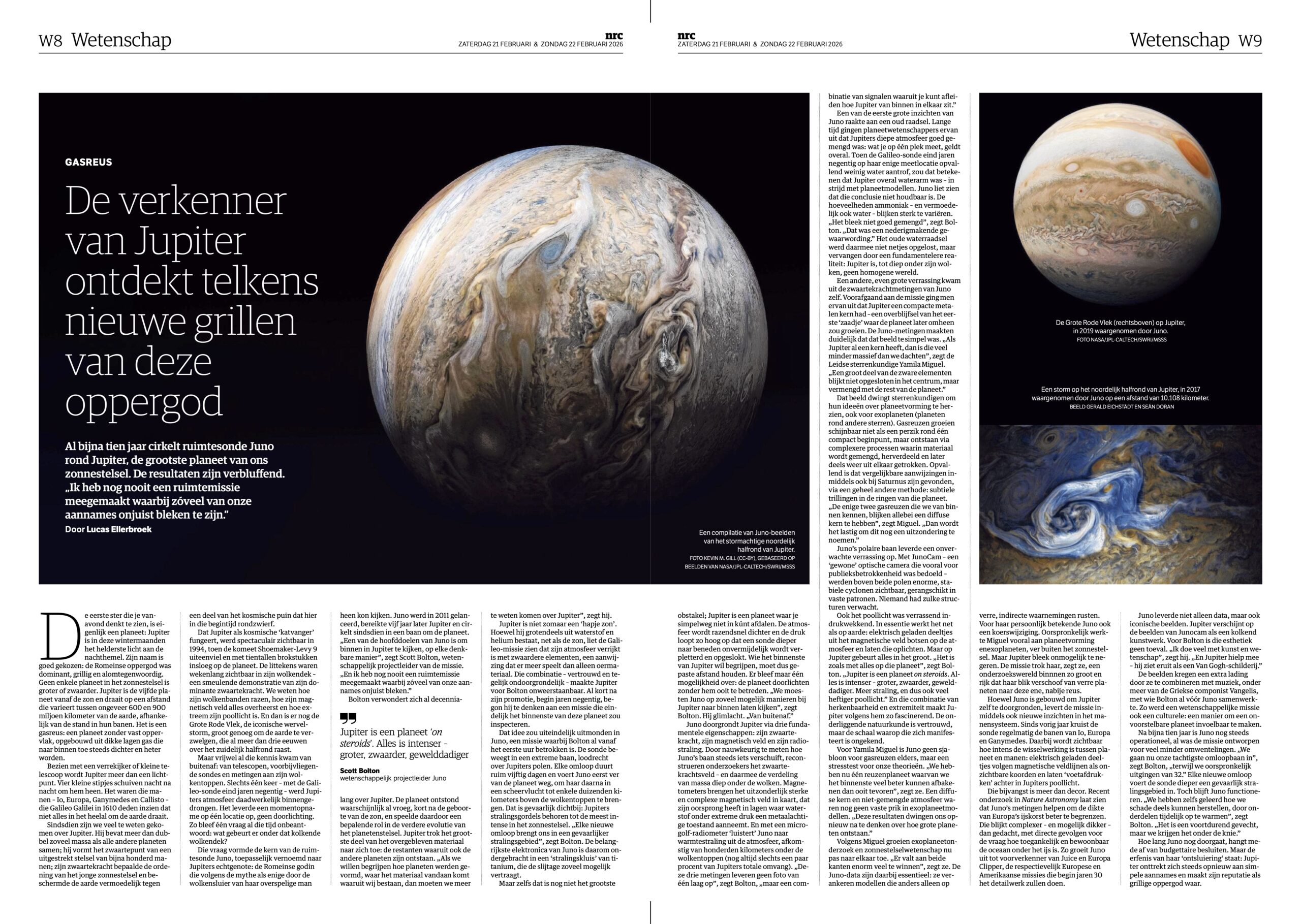
Juno’s polar orbit delivered another surprise. With JunoCam – a “simple” optical camera originally intended for public engagement – enormous, stable cyclones were revealed above both poles, arranged in fixed patterns. No one had expected such structures.
The auroras were also strikingly impressive. In essence, they work as they do on Earth: charged particles from the magnetic field collide with the atmosphere and cause it to glow. But on Jupiter everything happens on a grand scale. “It’s like everything on that planet,” says Bolton. “Jupiter’s a planet on steroids. Everything is more intense – bigger, heavier, more violent. More radiation, and therefore much stronger auroras.” The underlying physics is familiar, but the scale is unprecedented.
For Yamila Miguel, Juno is not a template for gas giants elsewhere, but a stress test for our theories. “We now have one giant planet where we truly know what’s happening inside,” she says. A diffuse core and a non–well-mixed atmosphere were not standard features in many exoplanet models. “These results force us to rethink how giant planets form.”
According to Miguel, exoplanet research and solar system science are only now beginning to converge. “There’s an enormous amount to gain on both sides,” she says. The Juno data are essential in this respect: they anchor models that would otherwise rest solely on distant, indirect observations. Personally, Juno also marked a turning point for her. Originally, Miguel worked mainly on exoplanets, far beyond our solar system. But Jupiter proved impossible to ignore. The mission, she says, drew her into a “Jupiter-sized bubble” – a research world so vast and rich that her focus shifted from distant planets to this one nearby giant.
Although Juno was built to understand Jupiter itself, the mission is now also yielding new insights into the moon system. Since last year, the spacecraft regularly crosses the orbits of Io, Europa and Ganymede. This makes visible the intense interaction between planet and moons: charged particles follow magnetic field lines like invisible cords and leave “footprints” in Jupiter’s auroras.
This by-product is more than decorative. Recent research in Nature Astronomy shows that Juno’s measurements help constrain the thickness of Europa’s ice shell. It appears more complex – and possibly thicker – than previously thought, with direct implications for how accessible and potentially habitable the ocean beneath the ice might be. In this way, Juno is becoming a pathfinder for JUICE and Europa Clipper, the European and American missions that will carry out detailed exploration in the early 2030s.
Juno has delivered not only data but also iconic images. In JunoCam’s pictures, Jupiter appears as a churning work of art. For Bolton, that aesthetic dimension is no coincidence. “I do a lot with art and science,” he says. “And Jupiter helped – it looks like a Van Gogh painting.”
The images were combined with music, including that of the Greek composer Vangelis, with whom Bolton collaborated long before Juno. Thus a scientific mission also became a cultural one: a way of making an unimaginable planet tangible.
After nearly ten years, Juno is still operational, although the mission was designed for far fewer orbits. “We’re about to have our 80th orbit,” says Bolton, “when we were originally designed for 32.” Each new orbit takes the spacecraft deeper into hazardous radiation. Yet Juno continues to function. “We’ve even learned how to partially recover damage by temporarily heating components,” says Bolton. “It’s a constant battle, but we’re learning how to do it.”
How long Juno will continue depends in part on budget decisions. But its legacy of unveiling is already clear: Jupiter repeatedly defies simple assumptions and lives up to its reputation as a capricious supreme god.