
“We don’t have a political agenda; we’re just trying to understand the universe.”
The American Laura Kreidberg became director of a Max Planck institute at a young age. While she studies distant worlds, she worries about the course of our own.
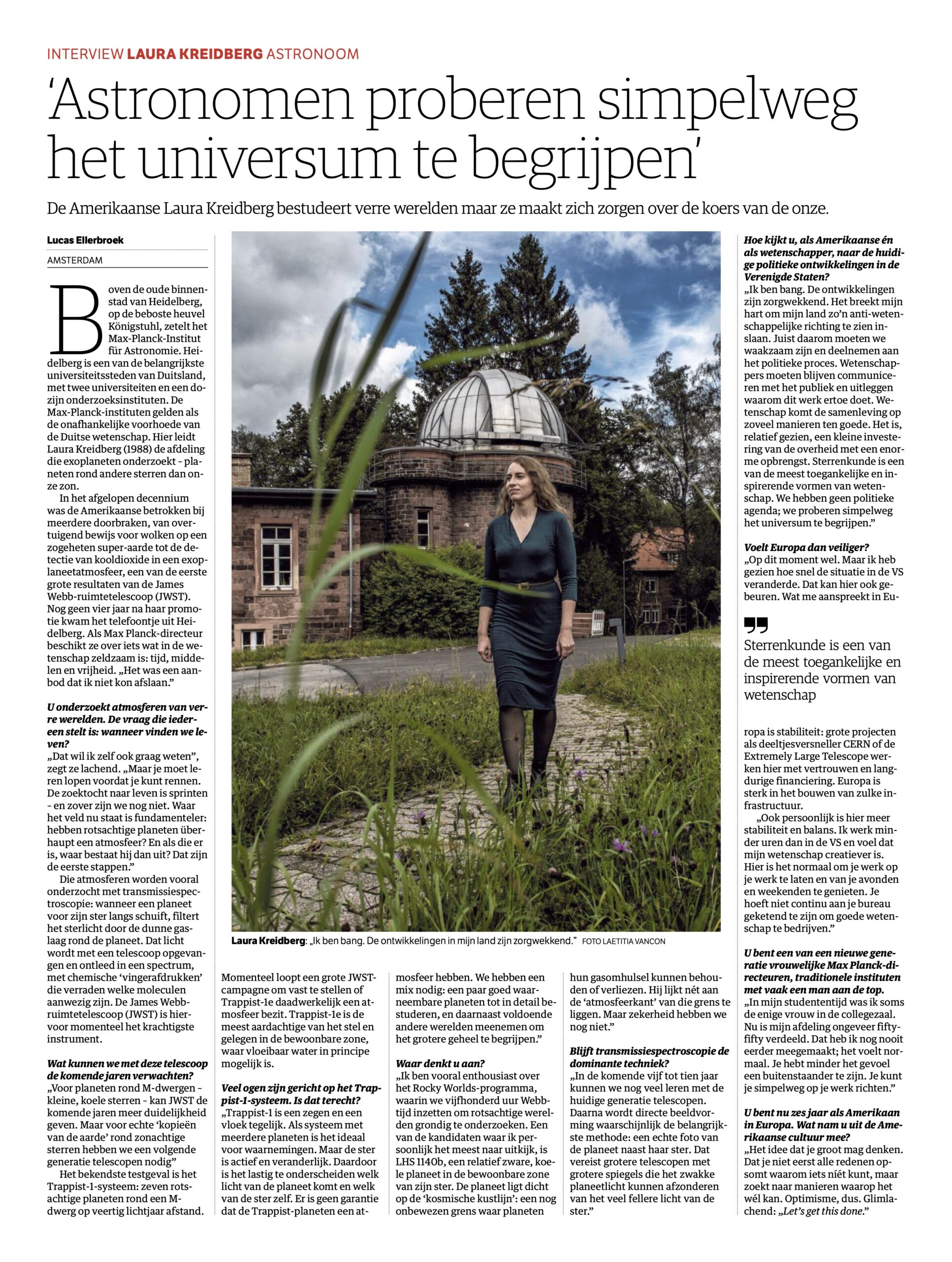
Above Heidelberg, on the wooded hill of the Königstuhl, stands the Max Planck Institute for Astronomy. Heidelberg is one of Germany’s leading university cities, with two universities and a dozen research institutes. The Max Planck Institutes are considered the independent vanguard of German science. Here, Laura Kreidberg leads the department that studies exoplanets — planets orbiting stars other than our Sun.
While public debate has long raced ahead toward the discovery of extraterrestrial life, she is trying to answer a more fundamental question first: do rocky exoplanets actually have atmospheres at all?
The American astronomer is at the forefront of exoplanet research. Over the past decade, she has been involved in several breakthroughs, from the first compelling evidence for clouds on a so-called super-Earth to the detection of carbon dioxide in an exoplanet atmosphere — one of the first major results from the James Webb Space Telescope (JWST). Less than four years after completing her PhD, she got a phone call from Heidelberg. As a Max Planck director, she holds a position that is rare in science: one with substantial time, resources, and intellectual freedom. “It was an offer I couldn’t refuse.”
You study the atmospheres of distant worlds. The question everyone asks is: when will we find life?
“I would love to know that myself,” she laughs. “But you have to learn to walk before you can run. The search for life is sprinting — and we’re not there yet. Where the field stands now is more fundamental: do rocky planets even have atmospheres? And if they do, what are they made of? Those are the first steps.”
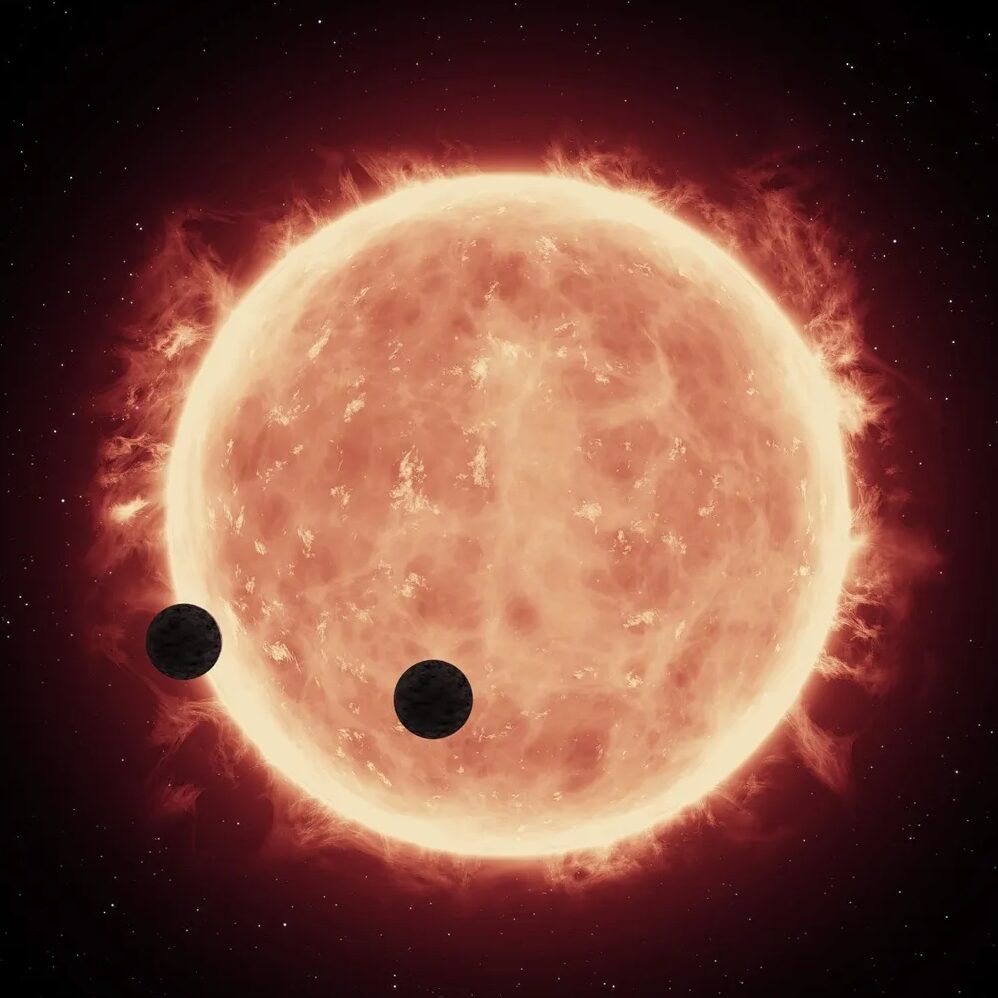
These atmospheres are currently studied primarily through transmission spectroscopy: when a planet passes in front of its star, starlight filters through the planet’s thin layer of gas. That filtered light is collected by a telescope and broken down into a spectrum, revealing chemical ‘fingerprints’ that indicate which molecules are present. The James Webb Space Telescope (JWST) is currently the most powerful instrument available for such measurements.
What can JWST realistically achieve in the coming years?
“For planets around M dwarfs — small, cool stars — JWST can provide much more clarity in the coming years. But for true ‘Earth twins’ orbiting Sun-like stars, we will need a next generation of telescopes.”
The best-known test case is the TRAPPIST-1 system: seven rocky planets orbiting an M dwarf about forty light-years away. A major JWST campaign is currently underway to determine whether TRAPPIST-1e — the most Earth-like of the seven, located in the so-called habitable zone where liquid water could in principle exist — actually possesses an atmosphere. [link to previous NRC-article Lucas]
Many eyes are on TRAPPIST-1. Is that justified?
“TRAPPIST-1 is both a blessing and a curse. As a multi-planet system, it’s ideal for observations. But the star is active and variable, which makes it difficult to disentangle what comes from the planet and what comes from the star itself. We have to be careful not to put all our eggs in one basket, because there’s no guarantee the TRAPPIST planets have atmospheres. We need a mix: study a few well-suited planets in great detail, while also including enough other worlds to understand the broader picture.”
What other ‘baskets’ are you considering?
“I’m especially excited about the Rocky Worlds program, in which we’re using five hundred hours of JWST time to study rocky planets in depth. One of the candidates I personally look forward to is LHS 1140b, a relatively cool and massive planet in the habitable zone of its star. It lies close to what we call the ‘cosmic shoreline’ — the boundary where planets can either retain or lose their atmospheres. It appears to sit just on the atmosphere side of that line. But we don’t know for sure yet.”
Will transmission spectroscopy remain the dominant technique in your field?
“In the next five to ten years we’ll continue making major progress with JWST. After that, direct imaging will likely become the most important method: taking an actual picture of a planet next to its star. That requires larger telescopes, both on the ground and in space, with mirrors capable of separating the faint light of a planet from the much brighter light of its host star.”
Such next-generation telescopes depend on political support. But the issue extends beyond a single mission. As an American and as a scientist, how do you view the current political developments in the United States and what they mean for the future of science?
“I’m scared. The developments are alarming. It breaks my heart to see my country moving in such an anti-science direction. That’s exactly why we need to remain vigilant and participate in the political process. Scientists need to continue communicating with the public and explaining why this work matters. Science benefits society in so many ways — both directly and indirectly. It is, relatively speaking, a small government investment with an enormous return. Astronomy is one of the most accessible and inspiring branches of science. We don’t have a political agenda; we’re simply trying to understand the universe.”
Does Europe feel safer?
“For the moment, yes. But I’ve seen how quickly the situation changed in the USA, and that could happen here as well. What appeals to me about Europe is stability: large projects like CERN or the Extremely Large Telescope are built on trust and long-term funding. Europe is strong in developing that kind of infrastructure.
On a personal level, there’s also more stability and balance. I work fewer hours than I did in the U.S., and I feel my science is more creative because I’m less burned out. Here it’s normal to leave work at work and enjoy your evenings, weekends, and vacations. You don’t have to be chained to your desk to do good science.”
You describe a different work culture. Do you also see changes within the institute itself? You are part of a new generation of female Max Planck directors — institutions traditionally led by men.
“Absolutely. When I was a student, I was often the only woman in the lecture hall. Now my department is roughly fifty-fifty. I’ve never experienced that before; it just feels normal. You have less of that constant feeling of being an outsider. You can simply focus on your work.”
You’ve now lived in Europe for six years. What have you brought from American culture?
“The idea that you’re allowed to think big. That you don’t start by listing all the reasons something won’t work, but instead look for ways it might. Optimism – and hustle.” She smiles. “Let’s get this done.”
CV – Laura Kreidberg
Laura Kreidberg (1988) studied physics and astronomy at Yale and received her PhD from the University of Chicago in 2016 for her work on exoplanet atmospheres. She continued her research at Harvard University as a Junior Fellow in the Harvard Society of Fellows. In 2020, she became Director of the Atmospheric Physics of Exoplanets department at the Max Planck Institute for Astronomy in Heidelberg, and currently also serves as Managing Director. Since 2022 she has also held a special professorship at Leiden University, and since 2023 at Heidelberg University.