A new view of the sky: Westerbork searches for flashes and extraterrestrial life
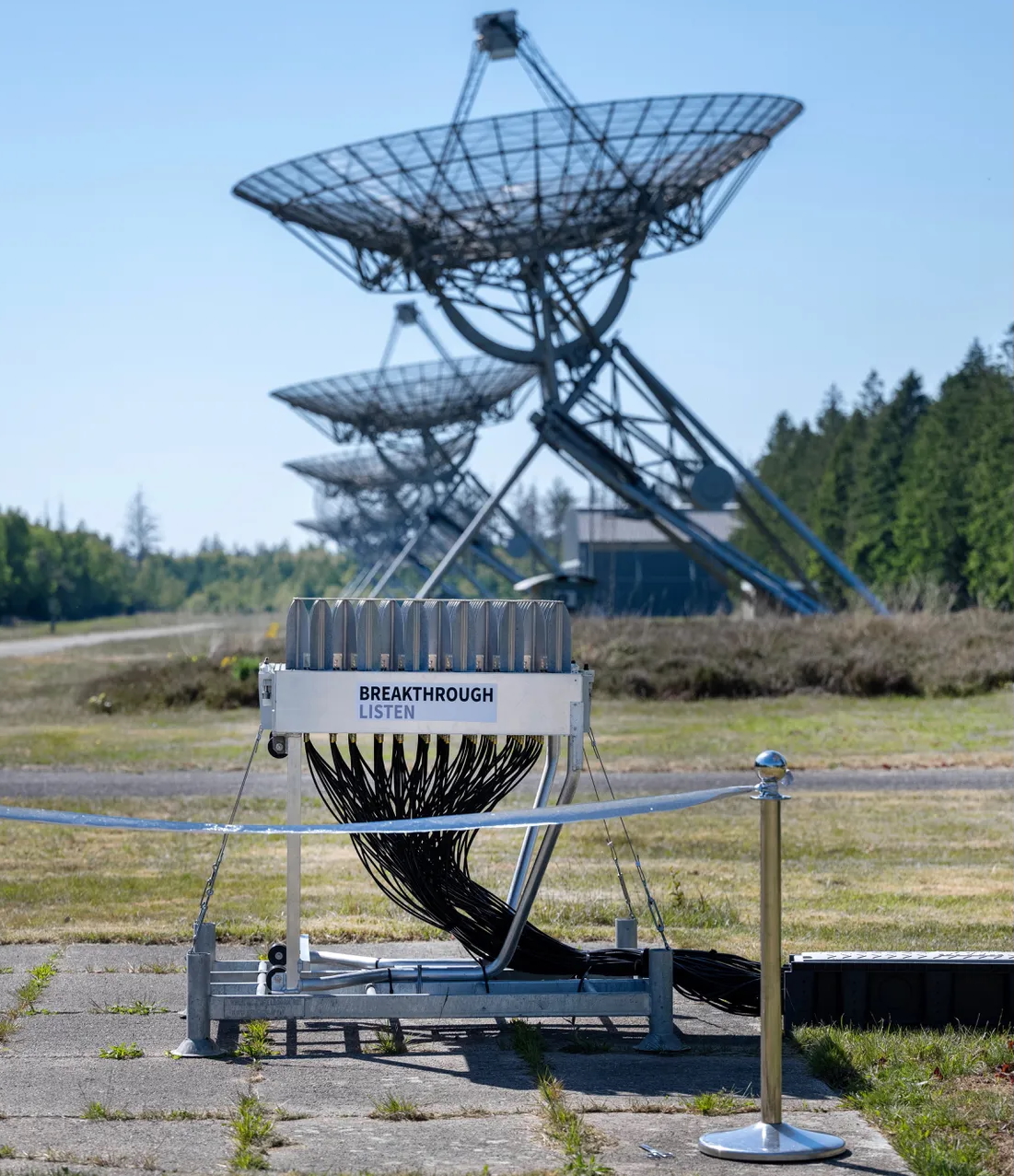
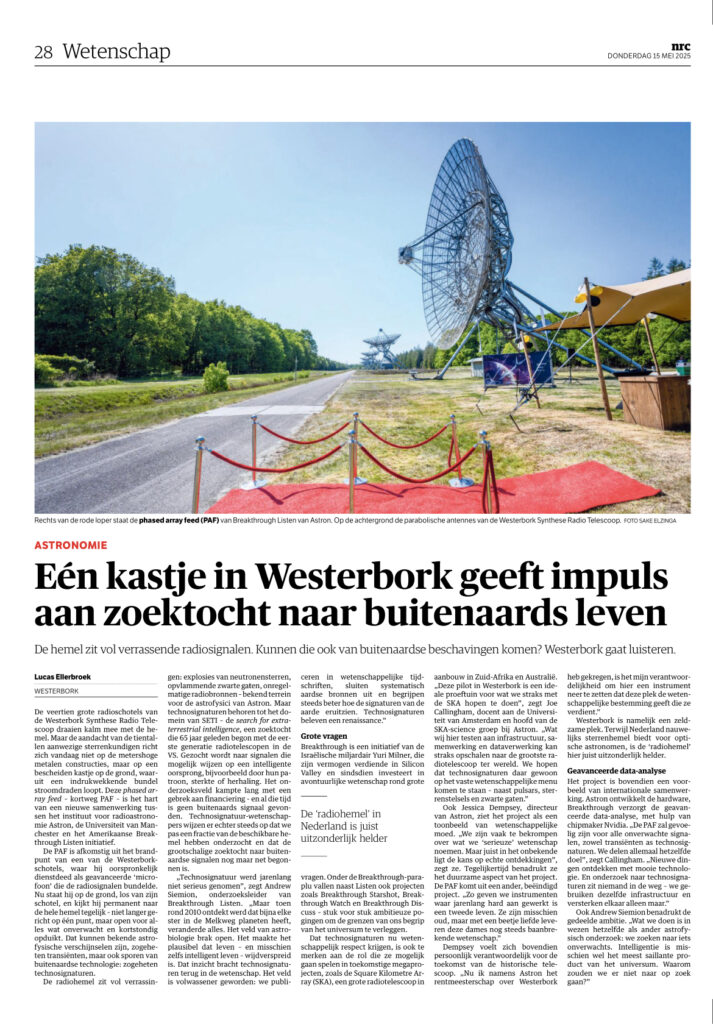
The fourteen large radio dishes of the Westerbork Synthesis Radio Telescope calmly rotate with the sky. But the attention of the dozens of astronomers present today is not focused on the meters-high metal constructions, but on a modest box on the ground, from which an impressive bundle of electrical wires runs. This Phased Array Feed – in short, PAF– is the heart of a new collaboration between the institute for radio astronomy Astro, the University of Manchester and the the Breakthrough Listen initiative headquartered at the University of Oxford. With a cutting of the ribbon, Drenthe provincial executive Willemien Meeuwissen and Pete Worden, chairman of the Breakthrough Prize Foundation, give the official starting signal.
The PAF was originally located at the focal point of one of the Westerbork dishes, where it served as an advanced ‘microphone’ that bundled the radio signals. Now it stands on the ground, detached from its dish, and looks permanently at the whole sky at once – no longer focused on one point, but open to anything that unexpectedly and briefly appears. These can be familiar astrophysical phenomena (so-called transients), but also traces of extraterrestrial technology: technosignatures.
The radio sky is full of surprises: explosions of neutron stars, flaring black holes, irregular radio sources – all familiar territory for the astrophysicists at Astron. Technosignatures, on the other hand, belong to the domain of SETI – the Search for Extraterrestrial Intelligence, a search that began 75 years ago with the first generation of radio telescopes in the US. The search is for signals that may indicate an intelligent origin, for example through pattern, strength or repetition. The field of research was long plagued by funding shortfalls – and in all that time no extraterrestrial signal has been found. However, technosignature scientists are quick to point out that we’ve only explored a fraction of the available sky, and that the search for extraterrestrial signals has only just begun at scale.
“SETI was not taken seriously for years,” says Andrew Siemion, research leader of Breakthrough Listen at the University of Oxford. “But around 2010, when it was discovered that almost every star in the Milky Way has planets, it changed everything. The field of astrobiology exploded. It made it plausible that life—and perhaps even intelligent life—is widespread. That insight brought technosignatures back into science. The field has matured: we publish in scientific journals, systematically exclude terrestrial sources, and increasingly understand what our Earth’s signatures look like. Technosignatures are experiencing a renaissance.”
Breakthrough is an initiative of technology investor and philanthropist Yuri Milner, who made his fortune in Silicon Valley and has since invested in adventurous science that addresses big questions. In addition to Listen, the Breakthrough umbrella includes projects such as Breakthrough Starshot, Breakthrough Watch and Breakthrough Discuss—all ambitious attempts to push the boundaries of our understanding of the universe. “We’re here today because we believe in collaboration, curiosity, and the power of technology to answer the biggest questions,” Worden said at the opening. “And what bigger question is: are we alone?”
The scientific respect that technosignatures are now gaining is also reflected in the role they may play in future megaprojects. “This pilot in Westerbork is an ideal testing ground for what we hope to do with the Square Kilometre Array,” said Joe Callingham, assistant professor at the University of Amsterdam and head of the SKA science group at ASTRON. “The infrastructure, collaboration, and data processing we’re testing here can scale up to the world’s largest radio telescope. We hope that technosignatures will simply become a regular scientific menu there—alongside pulsars, galaxies, and black holes.”
Jessica Dempsey, director of ASTRON, also sees the project as a model of scientific courage. “We are often too narrow-minded about what we call ‘serious’ science. But it is precisely in the unknown that the opportunity for real discoveries lies,” she says. At the same time, she emphasizes the sustainable aspect of the project. “The PAF was developed for the stopped Apertif project. By reusing it, we are giving instruments that have been worked on for years a second life. They may be old, but with a little love, these ladies are still delivering groundbreaking science.” Dempsey also feels personally responsible for the future of the historic telescope. “Now that I have been given stewardship of Westerbork on behalf of ASTRON, it is my responsibility to set up an instrument here that gives this place the scientific destination it deserves.”
Westerbork is, in fact, a rare place. While the Netherlands hardly offers a starry sky for optical astronomers, the ‘radio sky’ here is exceptionally clear. Thanks to a legally protected radio silence, the location is for radio astronomers what a high-altitude observatory is for their optical colleagues: quiet, remote and perfect for picking up signals from the universe.
The project is also an example of international cooperation. ASTRON is developing the hardware, Breakthrough is providing the advanced data analysis, aided by technology from chipmaker Nvidia. “The PAF will be sensitive to all unexpected signals, both transients and technosignatures. We all share the same goal,” says Callingham. “Discovering new things with beautiful technology. And technosignature science is not in anyone’s way – we use the same infrastructure and only reinforce each other.”
Andrew Siemion also emphasises the shared ambition. “What we do is essentially the same as other astrophysical research: we are looking for something unexpected. Intelligence is perhaps the most salient product of the universe. Why wouldn’t we look for it?”
With the cabinet on the floor, Westerbork gets a new kind of view of the sky – always watchful, always searching. Perhaps one day it will pick up the most extraordinary signal in history.